
Life with a Triumph T90
The Early Days and First Restoration
If you've read other parts of this website, you'll know that my first bike was a Bantam. The Bantam was a lot of fun and I went a lot of places on it. However, it was suffering from intermittent electrical problems and I was lusting after a Triumph Twin. If you weren't infatuated by the new Japanese bikes (a. I couldn't afford one, b. I have a stupid loyalty to British products) then the only bike to have was a Triumph. I still think the late 60s Triumph is the best looking bike ever - to me, it just looks right. In February 1973, when I was in the second year sixth form at school, I had saved up enough money to be able to get something - it would have to be fairly cheap as I didn't have much money. I went to see a Triumph T90 which was for sale in the local paper; took one look and left rapidly. The weeks dragged on, nothing else appeared in the paper and there was nothing I could afford in the dealers. So I rung up the seller of the T90 and asked him if it was still for sale - it was. So I ended up buying a pile of junk. It was so bad, he had to deliver it in his van as it wouldn't run. I got it started - you could go off down the road and then it would suddenly go very rich, cough out lots of black smoke and cough to a stop. My dad (very non technical) took one look, swore (which he never did normally) and stumped off back into the house.
The running problem was easy to sort out. The choke slide wasn't held on by anything. So when you pushed the choke lever down (directly on the carb - no cable) the lever caught the slide. You could then start the bike and release the choke - this would precariously lift the slide up and you would set off down the road. After 100 yards, the choke slide would drop off and take up a position in the venturi - full choke. That was sorted out by taking the whole choke arrangement out and throwing it away. As it didn't have an air filter, you started the bike by holding the back of your hand across the mouth of the carb, watching out for the flash if it backfired.
A quick description. Badly painted red frame with chrome on the oil tank, side panel, pillion hangers, fork legs and fork shrouds. All of the chrome slightly rusty - apart from the oil tank (as you'd expect on a Triumph, the leaks kept the chrome nice). Wooden number plates. Matt black petrol tank - a dragon on one side and "Triumph" stenciled on the other. Holes drilled on the front brake plate where a dummy air scoop had been fitted. Alloy mudguards - with the light cluster from a Raleigh Runabout moped doing service at the back. Basically, a dog.
As there was no lifting handle/rear stay on the back mudguard, the weight of the light cluster had caused a crack in the rear mudguard at the point where it was clamped to the subframe. The crack had been repaired with an alloy patch, pop riveted to the mudguard. Adding complexity was the fact that the previous owner had fitted shock absorbers that were an inch too short. Consequently, when you hit a pothole, the tyre would engage with the tails of the pop rivets making an interesting sound. Matters shortly came to a head when I was driving through town past the main bus queue when I hit a big pothole. The was a short screaming sound and then the whole back half of the rear mudguard, complete with Raleigh Runabout light cluster went flying through the air. I had to stop and then walk past the bus queue to reclaim the bits! The Raleigh Runabout cluster did sterling service for a number of years before I finally managed to get a proper replacement. Good quality parts were hard to find in the seventies.
The bike had a 6" headlamp which was a relic of the days when it had been a chopper. I quite liked it because it gave an air of originality. The magnetic speedo was very erratic so it was replaced by a chronometric speedo which I'd found in the special offers bin at H & L in Stroud. You only went into H & L in Cheltenham if you were absolutely desperate.
All of this needed some sorting so I stripped down the bike and got the bits off to Tombs and Bliss who were the local stove enamellers - staggeringly, they are still in business according to Google. At the time, they were very friendly to bikers. Frame spares in 1973 were difficult but I managed to get a couple of exposed spring shock absorbers from H & L in Stroud. They had come from the failed BSA Bandit project and were cheap - more important they were the correct length. A new rear mudguard plus a rear stay (fabricated in the metalwork shop at school) sorted out the back end.
My first epic trip was a school trip to the Isle of Man in Easter 1973. I managed to persuade the teachers to let me go on the bike and a friend called Paul Turner persuaded me to let him come with me. We had fun on the way up as I forgot to refit the oil tank cap after checking the oil at the start - a bit of rag did duty. We then had more fun at Keele on the M6 where a dodgy spark plug packed up. The left hand plug was a dismountable spark plug which you could take to bits; it was ancient and chose this moment to depart from the world. Fortunately you could get parts at motorway service stations in those days. The Isle of Man was great fun and I really enjoyed the bike. It was a real pleasure to have a decent headlight after the Bantam, even if it was only 6V. Coming back provided more entertainment. I decided to go down the back roads from Liverpool to Cheltenham rather than the motorway. Coming into Whitchurch the back end started to wallow and we quickly realised that we had a puncture. The first garage persuaded me to use one of those foam things - absolutely useless. We then managed to find a motor bike garage who replaced the knackered inner tube. That's when you find that the habit of Triumph owners in removing the centre stand isn't a good idea. I had been nursing the bike a bit on the way up and on the way back as I knew we had a long way to go. However, I was a bit fed up by now and we had lost a bit of time. So I decided to be a bit less tolerant and gave it a bit more throttle on the rest of the way back to Cheltenham. What fun! OK your eyes go a bit blurred and it seems like your hands are floating round the handlebars with the vibration but did it go! We did Bridgnorth to Cheltenham in an hour which was pretty good going. The noise from the engine and silencers was superb.
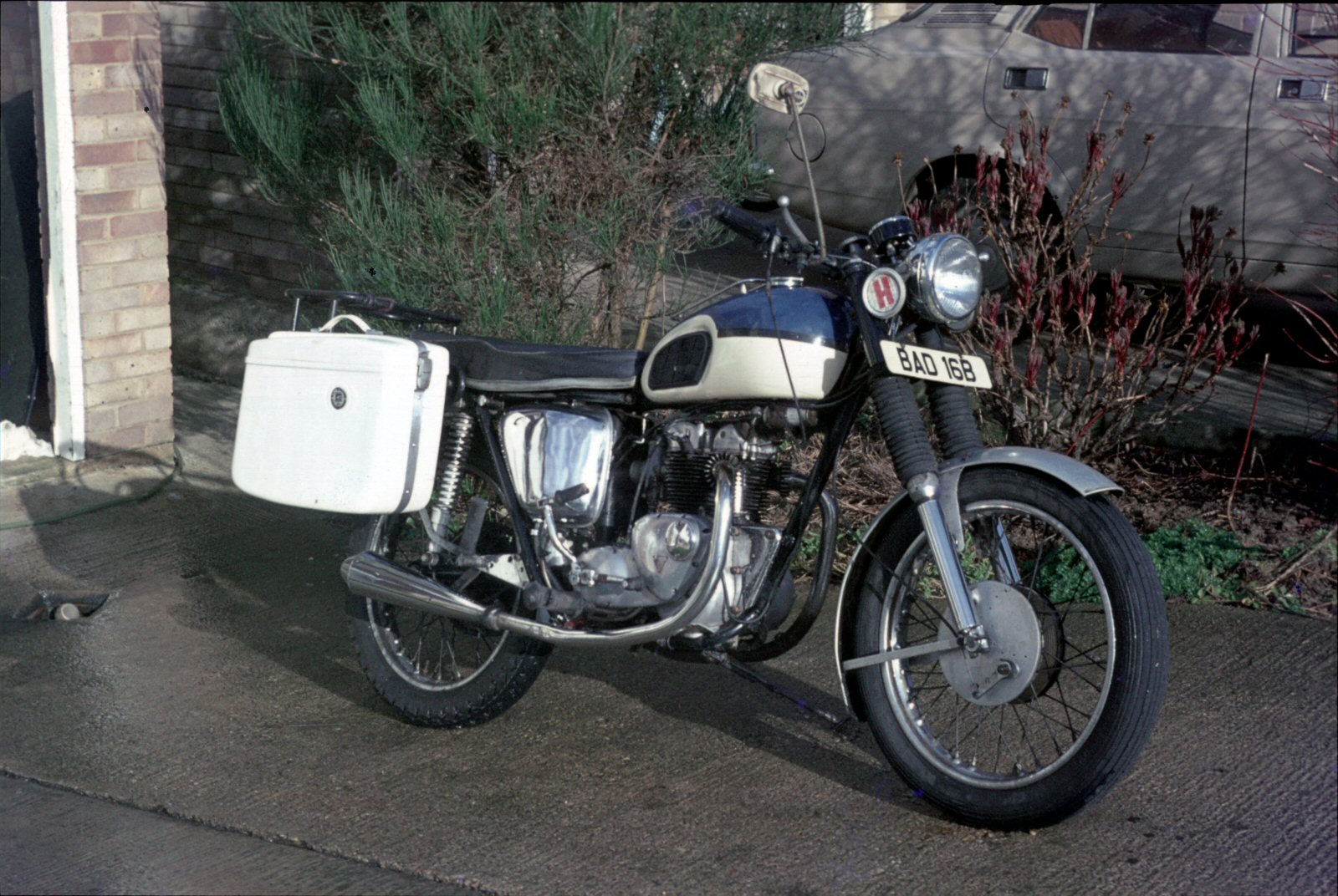
Here it is in 1974. All pictures can be viewed in higher resolution by clicking them.
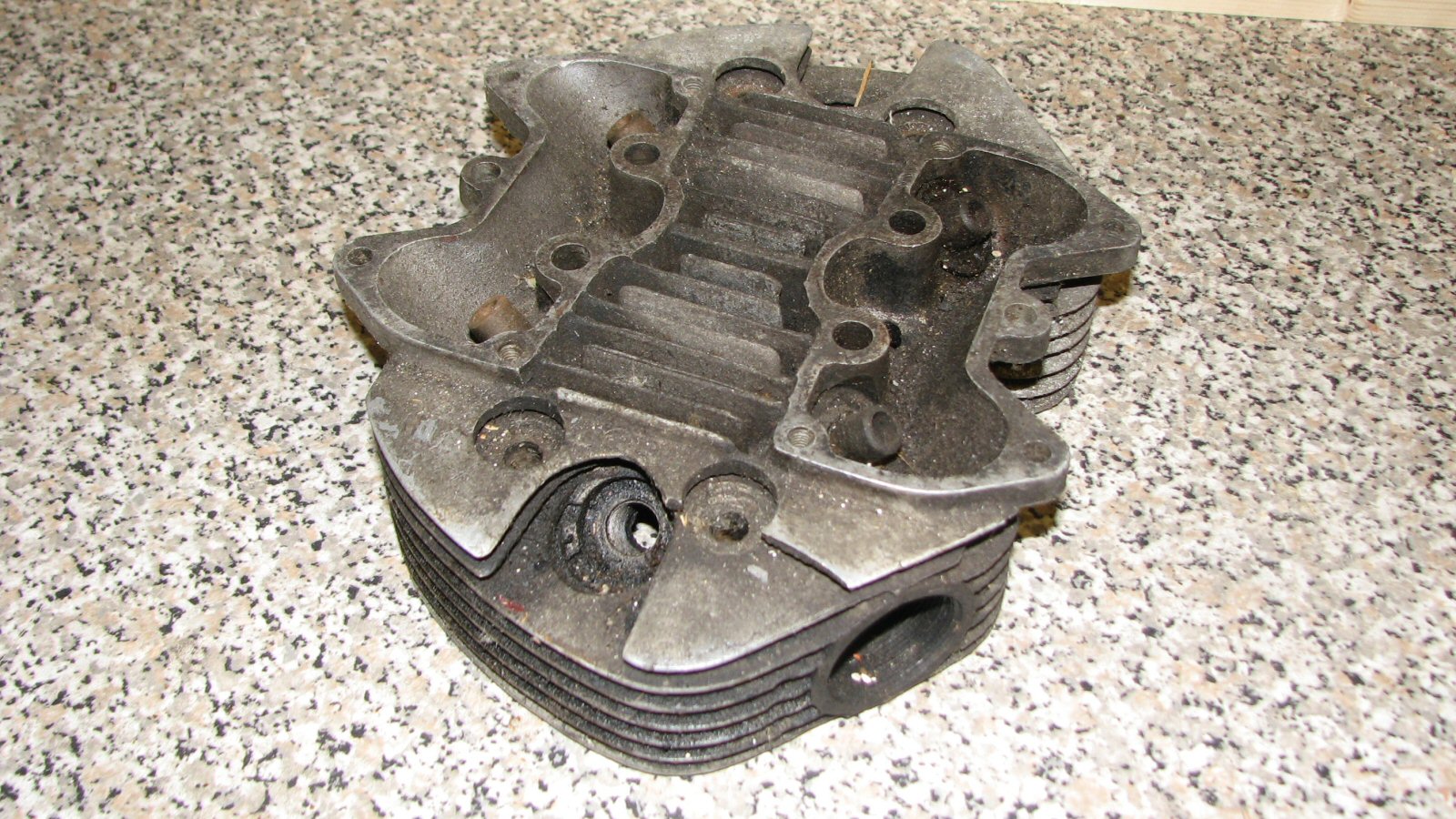
In the summer of 1973 I had the bike looked at by Fred Cheshire's in Cheltenham - I can't remember what for. I had a temporary job in the summer after leaving school. The plan was to pick up the bike after work on Friday and then drive to North Wales to go climbing for the weekend. When I picked up the bike, I noticed that a fin on the cylinder head was broken. Consumer rights weren't a strong point in the seventies and I was told what to do. Here's the cylinder head in early 2010 after many years in various attics.
I then set off for North Wales. I decided to stop at Ledbury just to make sure that the oil was OK. A look in the tank showed an empty tank! After filling it with oil, I decided to return home. I remember going down the main street in Ledbury, looking round and seeing a trail of oil all the way down the road. The return side of the lubrication system wasn't working. I drove as far as I dared but then had to push it the remaining 16 miles to Cheltenham (still went climbing after catching the overnight train. It was a bit of a pain when I was walking up the A5 from Bangor when I worked out that the reason my pack was so heavy was because the tool kit was still in it!). I didn't find any fault but gave the oil lines a good cleaning.
I joined the RAF in October 1973 and the bike was my sole means of transport. Shortly before joining I purchased a set of Craven panniers and a rack. They were the gold standard in those days being used by the police. The panniers were an excellent way of carrying gear and barely affected handling. The rack was a different matter as I had to learn how to pack things on it properly. When I set off for the RAF, I made the mistake of packing everything on the rack to leave the pillion seat clear. Wrong! I ended up driving 80 miles with the front wheel wobbling like crazy. I soon learnt to pack everything so it was as far forward as possible.
The last epic in 1973 was returning to the RAF camp in late October 73 after a weekend climbing in the Peak District. Passing the airship hangars at Cardington near Bedford I was roused from the numbing roar by a load of sparks coming from the place where the left silencer should have been (it was dark). I stopped and found the rear pillion mounting bracket had broken away from the rear sub frame. As the silencer had parted from the exhaust pipe, the only thing retaining the silencer, pillion footrest and bracket was the strut which supported the rack from rear footrest. You can see the strut in the top picture above. I can't remember how I got back but, almost certainly, it involved one or two bootlaces. A good friend in Cheltenham arranged for the subframe to be rewelded.
For the rest of 73, the bike got me away from the RAF as quickly as possible after Saturday lunchtime. There wasn't much traffic on the roads as this was the time of fuel shortages. The bike did over 90 to the gallon so it didn't affect me much - I have still the ration book. The lack of traffic was a clear advantage. It was cold work in the Autumn on a Sunday night. I would generally arrive at RAF Henlow frozen solid. I would stop the engine by holding the brakes and letting the clutch out in first - I couldn't grip the ignition key. After I'd thawed out on a radiator in the reception area for 10 minutes, I would go and turn the ignition off. Coming home for Xmas in 1973, it was foggy, it was dark and I wanted to get home. I had a nice little route from Henlow to Cheltenham on B - roads. So I sat on the cat's eyes at 60mph and hoped that nothing would come the other way! I think the maximum distance I could see was 2 or 3 cats eyes in front.
After passing out in January 1974, I went climbing with a mate in the Lake District and drove up from Cheltenham (actually I cheated and caught the train to Liverpool - remember when you could take a bike in the guards van for half price?). The final bit up the M6 was in the dark and I thought that the lights were a bit dim. The light switch had broken so it wasn't able to charge with the lights on. We had to beat a swift exit from Langdale after one day when a load of snow dumped on us. Riding down Langdale in deep snow wasn't a lot of fun!
After officer training, I was posted first to Church Fenton and then to Linton-on-Ouse in Yorkshire. The trip up to Yorkshire was in February and I almost drowned on the M5 as it was raining that hard. The next bit of entertainment was in the summer of 1974. I'd gone to the North York Moors on a lovely summer's day. Having stopped to admire the view, I became aware of a hissing noise - psst, psst, psst. I had a look around and spotted a drip from the petrol tank to the cylinder head. I still rode the 40 miles home on the theory that the wind would blow the petrol clear of the cylinder head. A friend offered me a replacement petrol tank. The problem that would cause a real headache in years to come was that the replacement had a flat base, whereas my broken tank had recesses for the coils.
I do remember riding back to Cheltenham one Friday night after a week's survival course. After coming down the M18 from Rotherham, I got some way towards Leeds on the M1 before I realised that I had taken the wrong turning.
In 1975 I managed to wangle a posting to Outward Bound in Ashburton, Devon. The summer of 1975 was magnificent and I remember many happy evenings blatting across Dartmoor on a summer's evening. Here's the bike in Devon in 1975
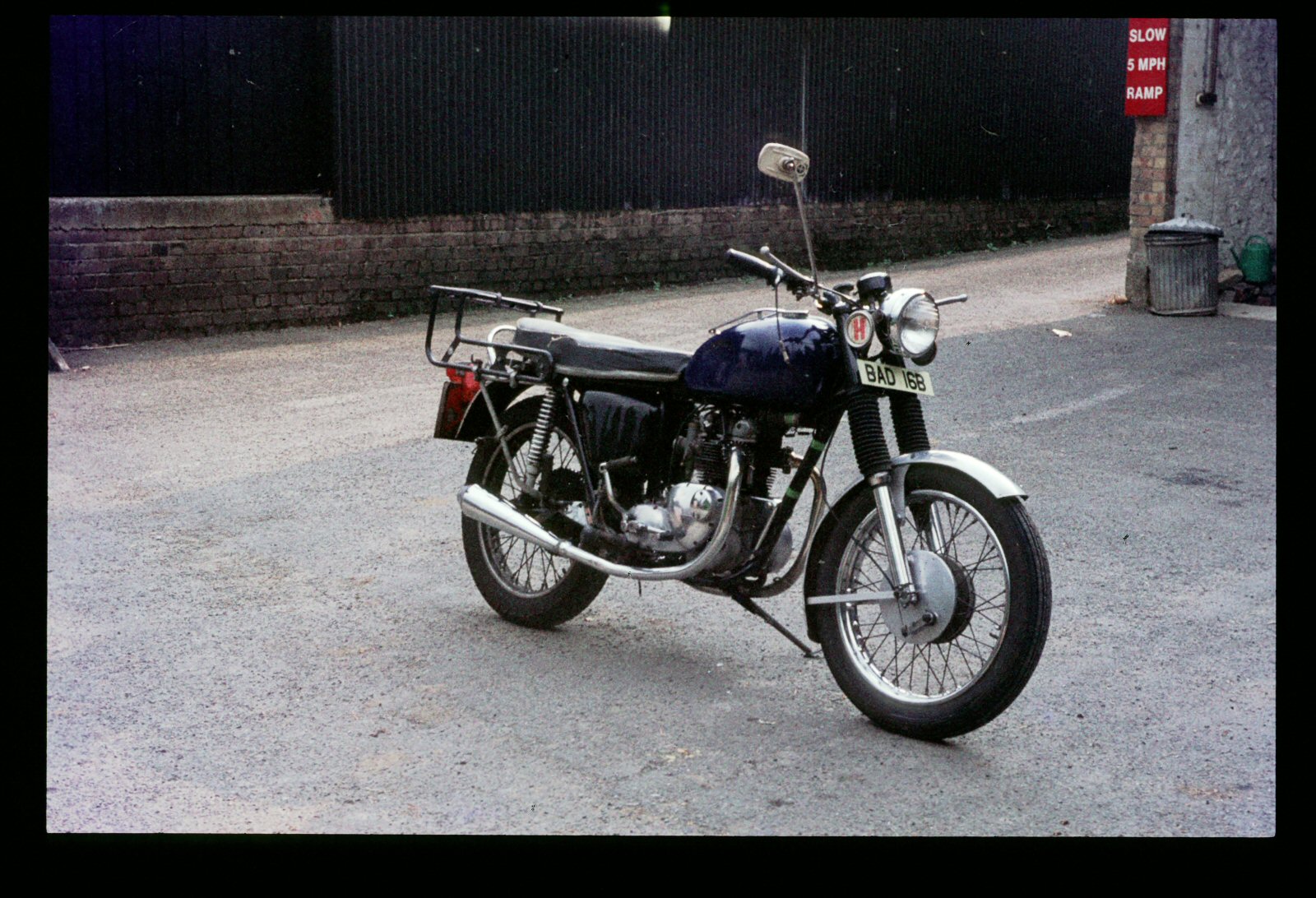
The replacement tank is now one colour and I haven't managed to fit the badges or the knee rests. The badges came much later when I managed to clean out the fixing holes. The oil tank is now black but the chrome fork leg and pillion hangar are still there. You can see the Raleigh Runabout light fixing. In this era, getting hold of tinware was virtually impossible. You can see that my home made rear lifting handle has been replaced by a lifting handle from a much later model - it did a good job!
1976 started with a trip from Cheltenham to North Luffenham, near Stamford. I'd driven down from the Lake District in the morning and then decided to go to North Luffenham on the bike (in early January and on the same day). Nearing the end of the journey I can remember going too fast into a 90 degree bend near Morcott in the dark. I was still on 6V lighting at this stage. Fortunately the back brake did the job; the front brake has always been virtually useless. I can also remember being concerned about something else - I think it must have been smoke from the exhaust which was a precursor for worse to come.
In March, I left the RAF and went to work for Outward Bound in Eskdale in the western Lake District. After a couple of weeks I went south on the train to pick up the bike. On the next day, I set off north up the M5. Shortly after passing Strensham services it became obvious that the big end had expired. Fortunately I had joined the AA the year before and rang them expecting a relatively simple ride to the Lakes. In your dreams! First I had to push the bike back onto the motorway after mistakenly pushing it back to the services - the AA wouldn't take calls on the service area. After a delay, I was picked up by a local garage and taken to Worcester. After another delay, I was picked up by the AA and taken to Stoke - where it started to snow. From there, another driver took me to Manchester where chaos prevailed. The Stoke AA driver was so disgusted that he took me on to Lancaster. Here I was put on the back of a low loader with the bike against the rear of the cab. Shortly after turning onto the A590 at Levens, the bike decided to join us by mashing through the rear cab window. I decided to get the AA to take me to Ulverston railway station where my Triumph Herald estate was parked. The last service the AA provided was to help me remove the forks from the bike and get it into the back of the Herald - this at 2am in the snow! I got to bed around 3am and had to get up at 6 to pack for a 3 day mountain expedition.
When I next got some spare time I was able to extract the bike from the car to rebuild the front end and dismantle the engine. Here the disaster got bigger. Having got the engine out of the frame, I noticed a convenient vice in the workshop. I put the engine into the vice and wandered off to get some tools. On returning to the workshop, I was just in time to see the engine toppling to the floor. The chaincase cover had already been removed and the engine landed on the rear of the chaincase. As the inner cover had been removed, there was no real strength remaining so it broke across the rear chaincase area, essentially through the line of the gearbox sprocket. Knackered big end, knackered engine - there's not much lower you can go!