

 |
Back to Index |  |
Next |  |
Last | ||||
| 149 records found. Page 1 of 15 displayed. | |||||||||
For most of the photos on this page, you can click the image for a larger picture.
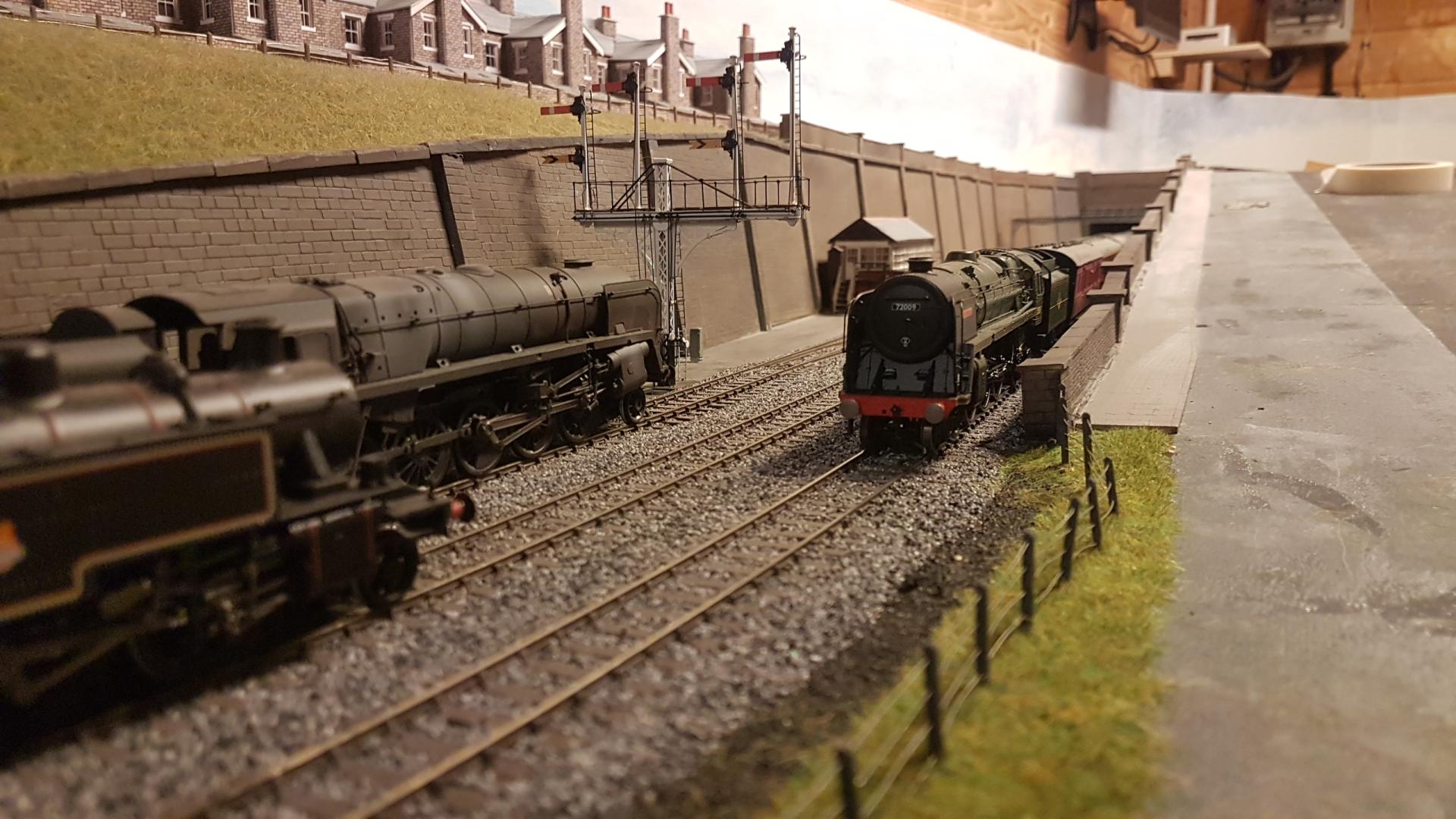
Having built the shed I now have the space to indulge in another project. The last time I had a fully working model railway was in the mid 1960s. I made a start at building one in my last house but the room wasn't really big enough for what I wanted to do. Now I have a shed that's pretty big - 12m by 3m. With a layout this size I need to be aware of my limitations so I shall stick to OO and , at least in phase 1, use PECO Code 75 pointwork with C + L Finescale track. Steam era - 1956 - 1958. Semaphore signalling wherever possible although the control may be by PC with entrance/exit route setting. The location is West Yorkshire so that I can mingle LMR and ER classes.
This will be a DC model railway, I see too many people fiddling with controls for DCC. Also, I think the signalling controls should be separate from the driving controls - like the real world.
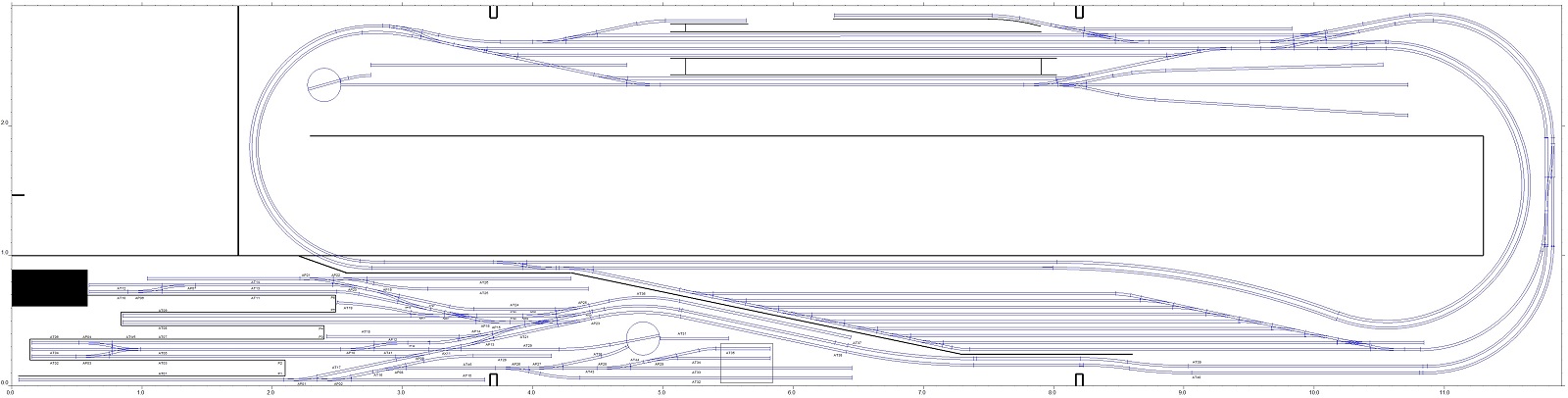
Here's the start of the plan. It's designed for operating and for watching the trains go by. Terminus on the bottom and through station at the top. The terminus is getting close to finalisation, the through station is only at an early stage. The terminus is from an old Cyril Freezer plan turned upside down. It will be slightly higher than the main line just to add a bit of difference. My last attempt was using a CF plan that had separate levels but the gradients were too steep. Here, I've kept to a maximum gradient of 1 in 100. All planning has been done on XTrkCad (www.xtrkcad.org). I tried to use Templot but the plan is built around PECO dimensions and would be much longer with true to reality dimensions which Templot uses.
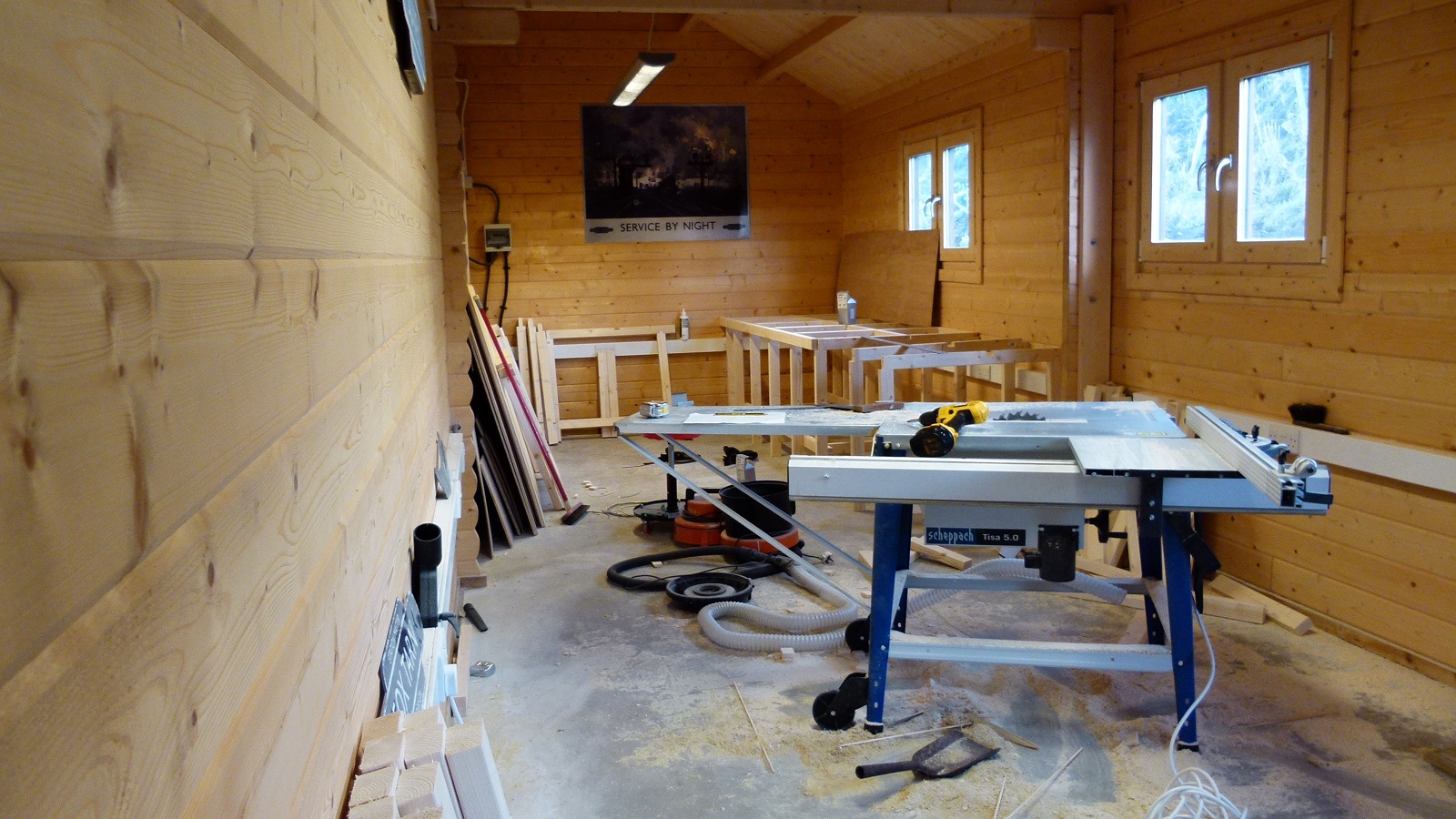 |
February 2015 So a start has to be made on the baseboard. Get the foundations right and it prevents problems later on. B & Q were selling some pretty clean wood (63mm * 38mm) at a fair price. So that forms the basic frames which I have to make a lot of. I used the XTrkCad plan to ensure that none of the cross joints were near point motors. This was a big step forward after my last layout where I had to do some awkward juggling. As I've got a lot of wood to cut, I bought a table saw which seems seems to generate prodigious amounts of sawdust. When making lots of repetitive cuts like this, it saves hours of work. The DeWalt battery drill is amazing, it gets hours of hammer but still keeps going. I am on my 3rd set of battery pairs. |
 |
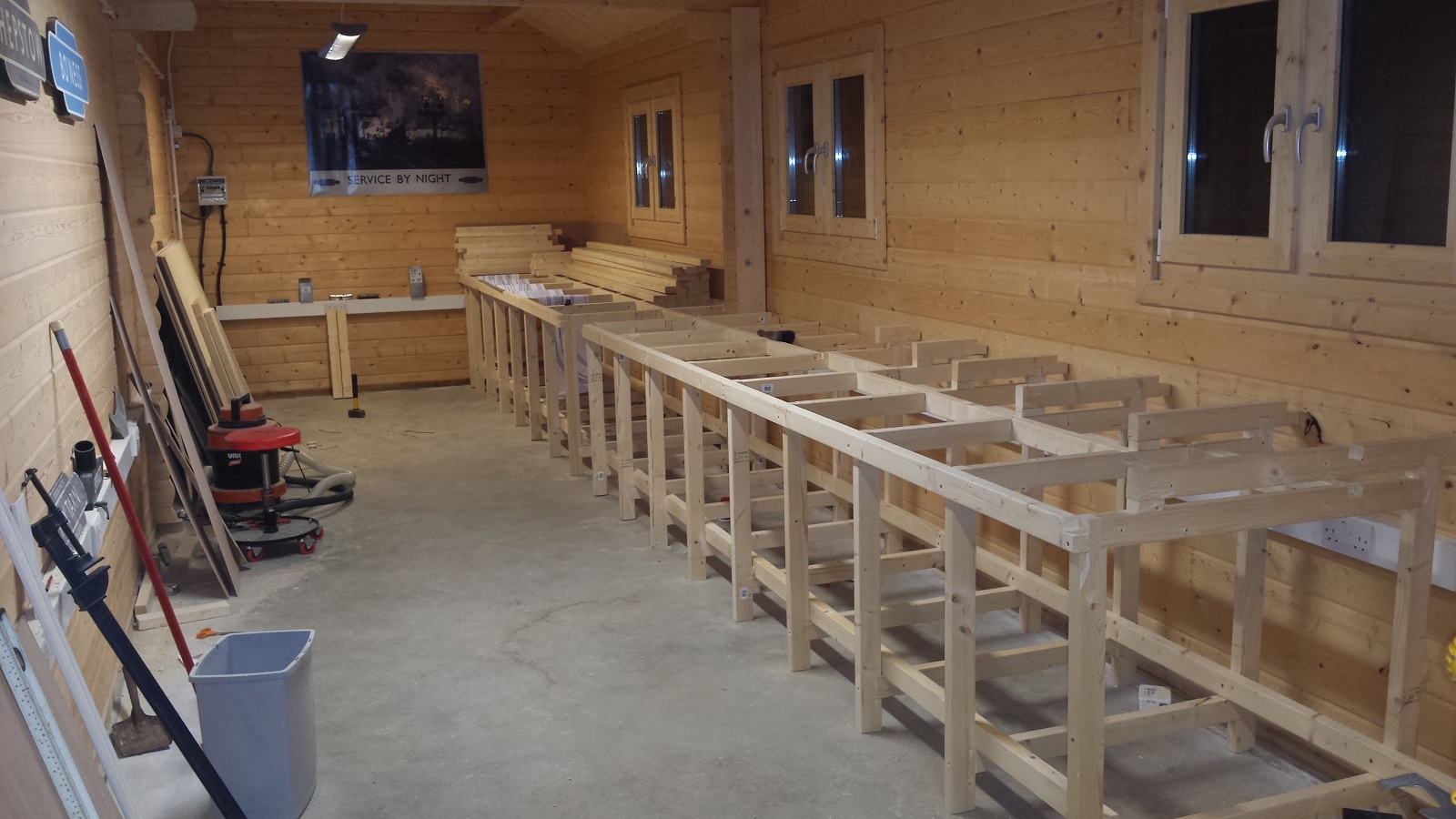
February 2015 This shows how the base goes together. I first started making a set of parts for the individual frames, you can see one on the rear wall. These are then connected through a set of horizontal timbers with halving joints. The joints are glued and screwed. On the right you can see one of the 2 stub walls per side of the shed which I have to work round. |
 |
February 2015 On to the second bay - the bays being between the stub walls - and the level of the terminus can be seen emerging. This will be the loco yard area. As I don't have lots of time and as I'm not that good at woodwork, I'm using halving joints, glued and screwed - I do like to build bomb proof structures. The middle bay has to be pulled out so I can fit the backscene sheet. Once back in place, I will fill the gap between bay 1 and bay 2. The top cross member is staggered to avoid point motors. |
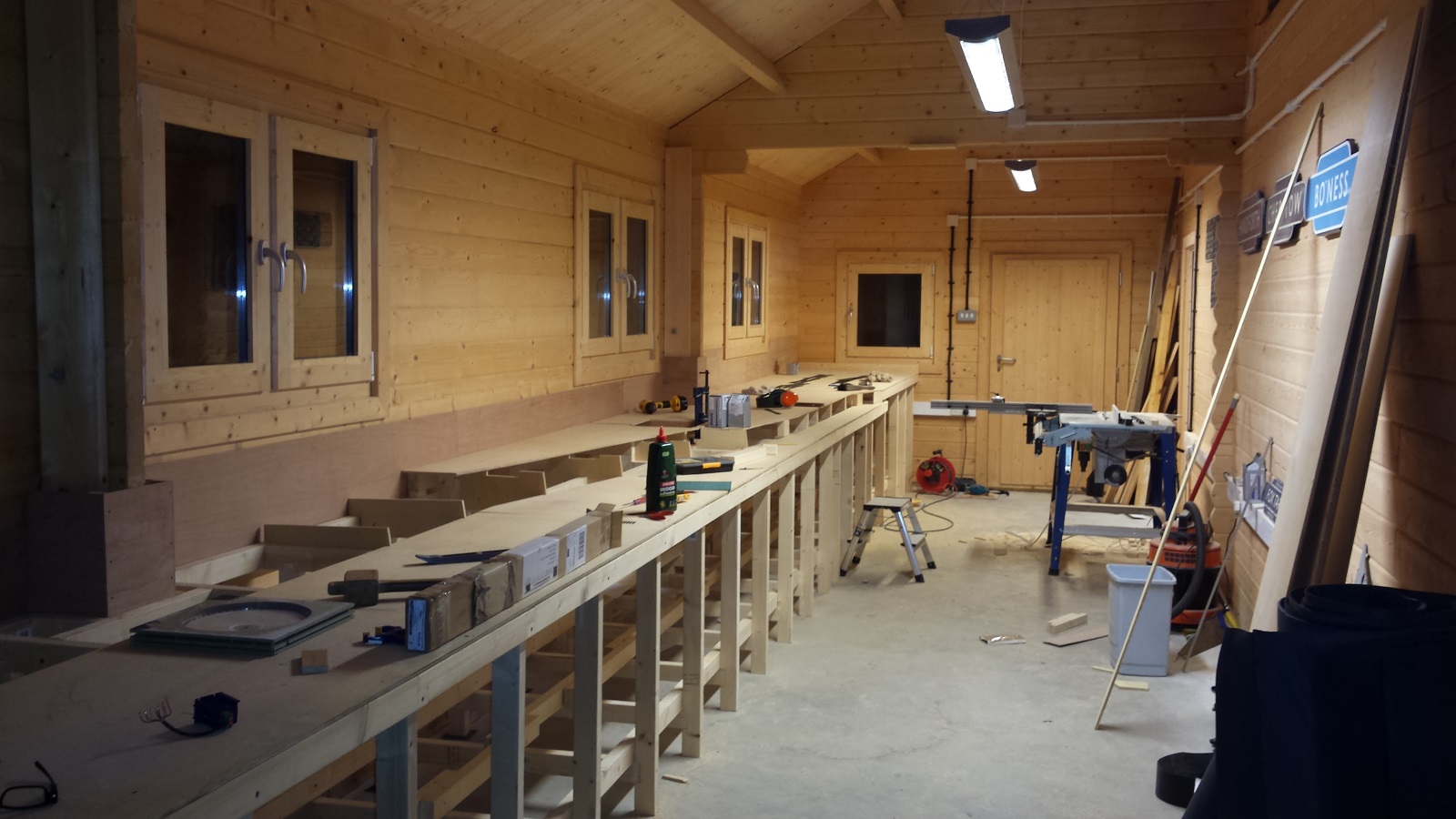 |
March 2015 The surface is 9mm plywood. The terminus station board is now in place and the backboards are in place. I'm finding that XtrkCad is not exactly correct so I'm having to make space for point motors. You can see that the hole for the turntable has been cut out. I need to add another support for one end of it. The station throat is the complicated bit and I'm going to have to be careful here. I've got a roll of 3mm foam so that will be going underneath the track. |
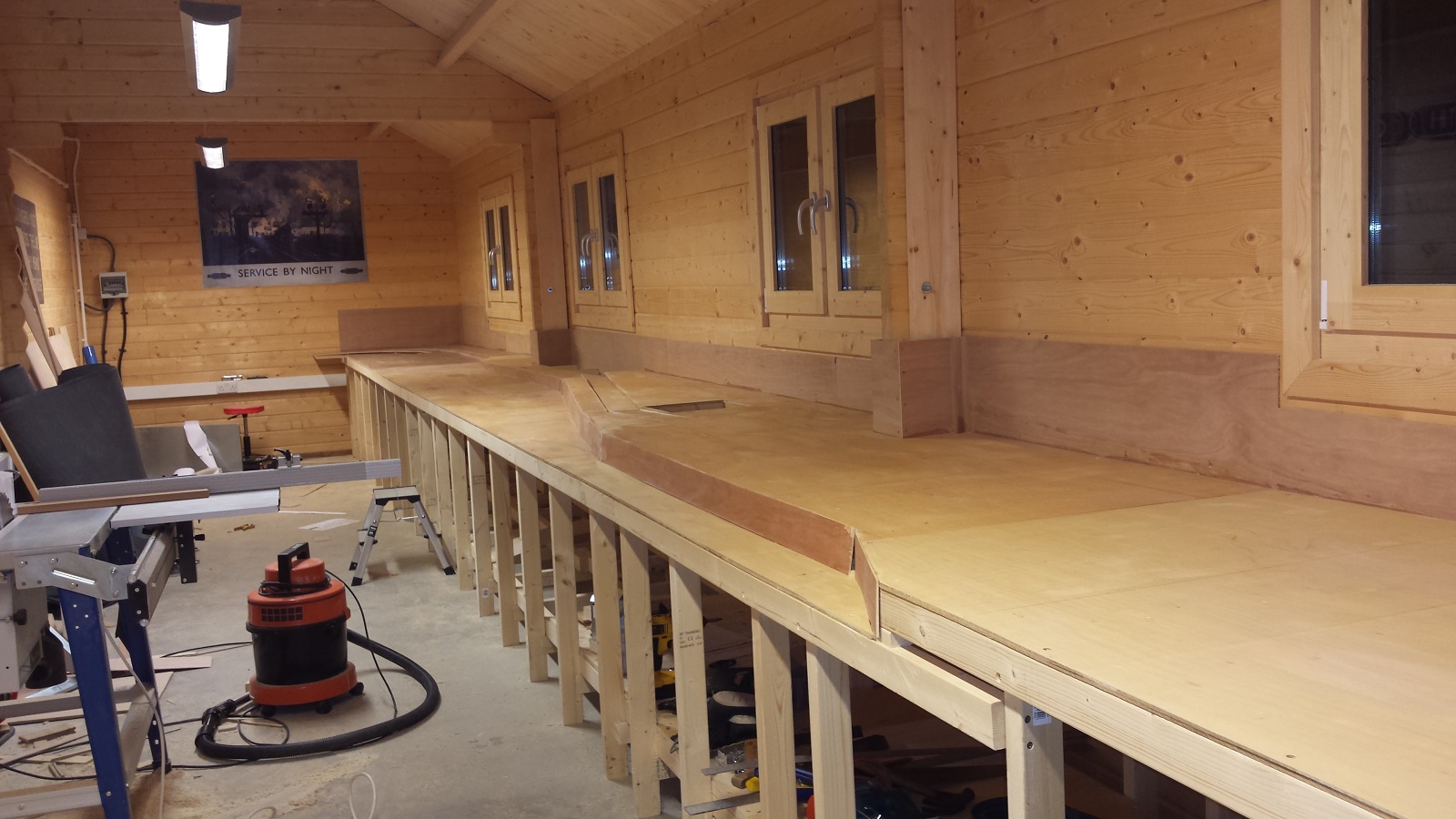 |
March 2015 The main construction work is complete on the terminus side. The track from the terminus drops at 1 in 100 to the junction which will be on the other side of the shed. The fiddle yard (or carriage sidings) is to the left of the turntable well. All of the surfaces have been primed with PVA at 1 unit PVA to 5 units water. Mix the water to the PVA not the other way round. Next job is to start sticking down the 3mm foam which will be the underlay to the track. For interest, nothing can be fixed to the walls; fortunately the frame is strong enough so I don't need to worry about it. Apparently the shed will grow and shrink with the seasons. You can see that the vertical conduit wiring is flexible to allow for this. |
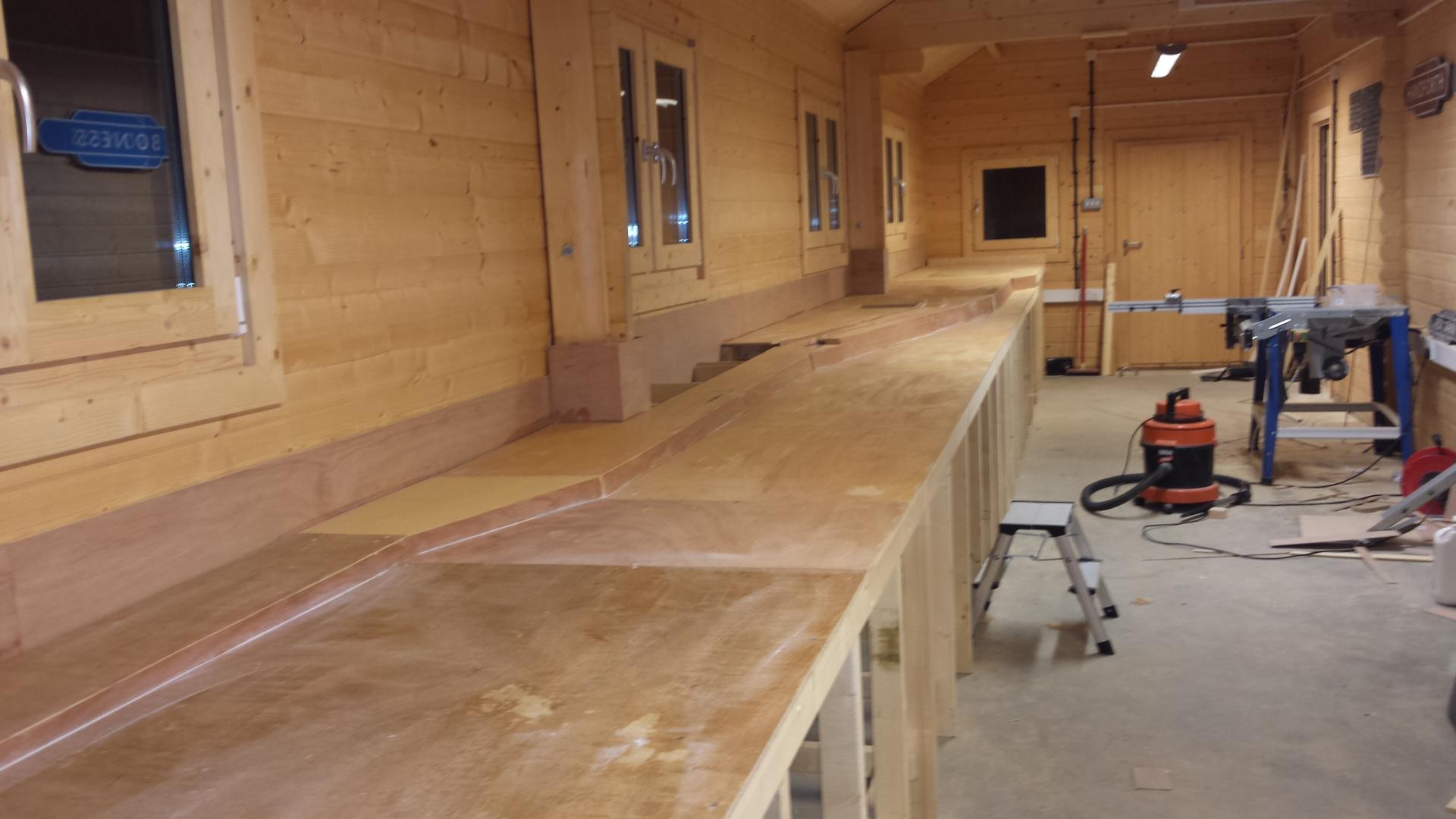 |
March 2015 Looking the other way on a not very well exposed photo, you can see the station area. |
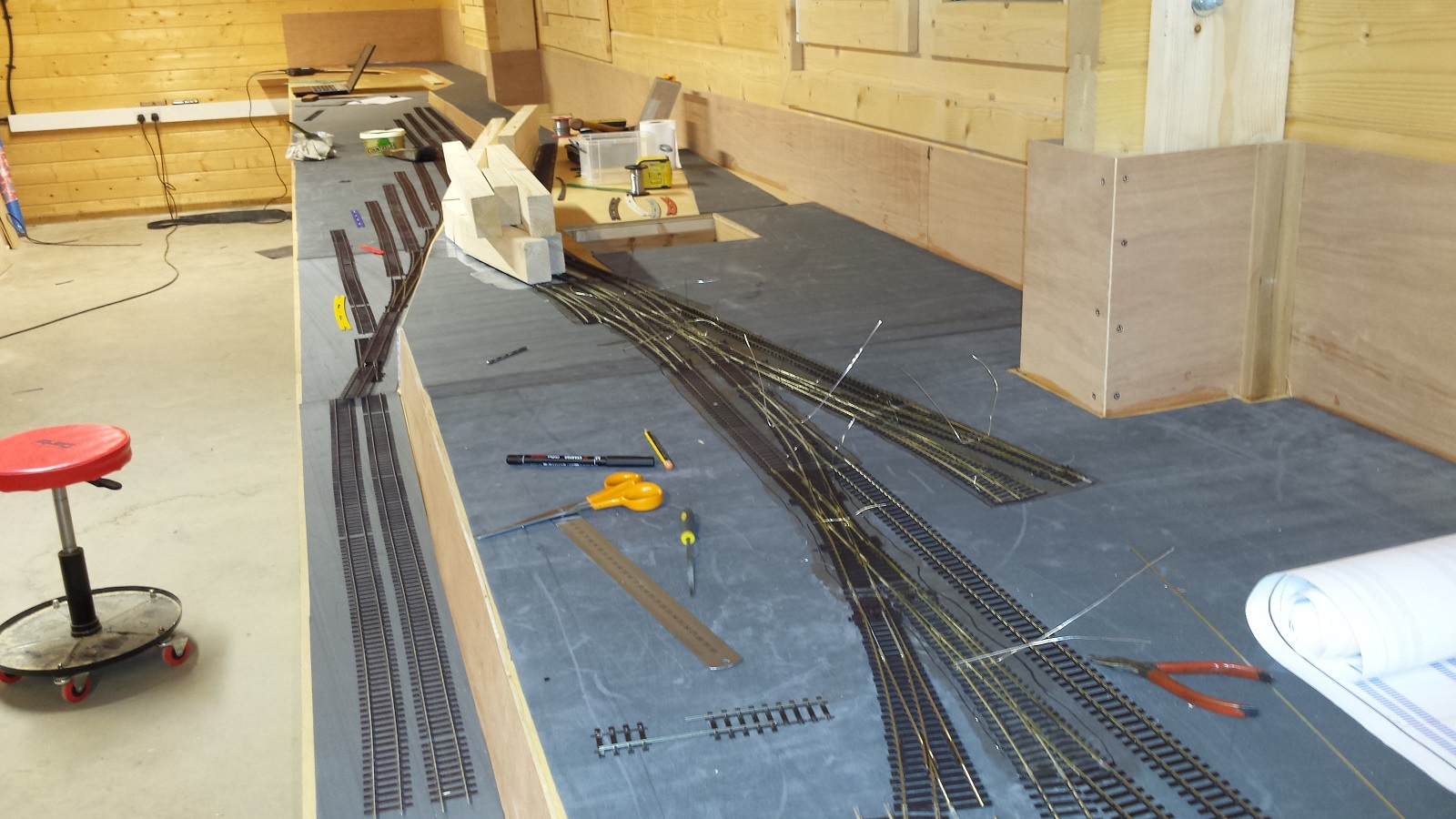 |
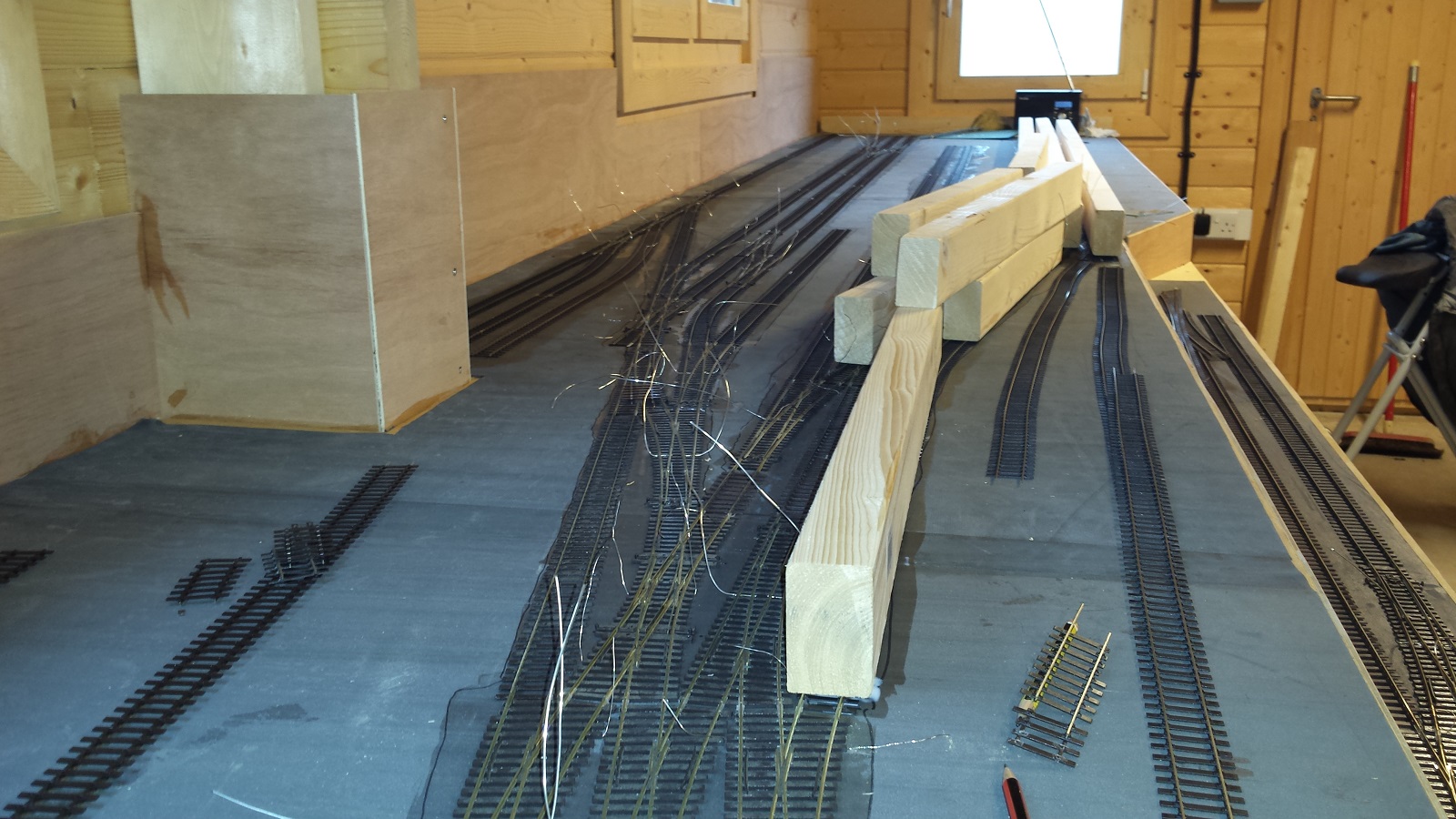
March 2015 Tracklaying starts! I'm using Peco Code 75 S + C (Switches and Crossings) and C + L Finescale track - it has the right sleeper spacing for OO gauge. I would have like to have built C + L pointwork but there arent enough hours in the day. I modify the points by
I use a Dremel slitting disc to remove the sleeper chairs next to a joint and lay everything down with no fixing. I then mark where the point tiebars operate so I can drill a 5/16" hole where the point motor wire needs to come up. I then take everything up and paint the area of the new track with PVA diluted with water 50:50. The track goes down and I use a Trackesetta template to get the curves right and get things as straight as I can. This is the station throat. The wires are the droppers for the track power. |
 |
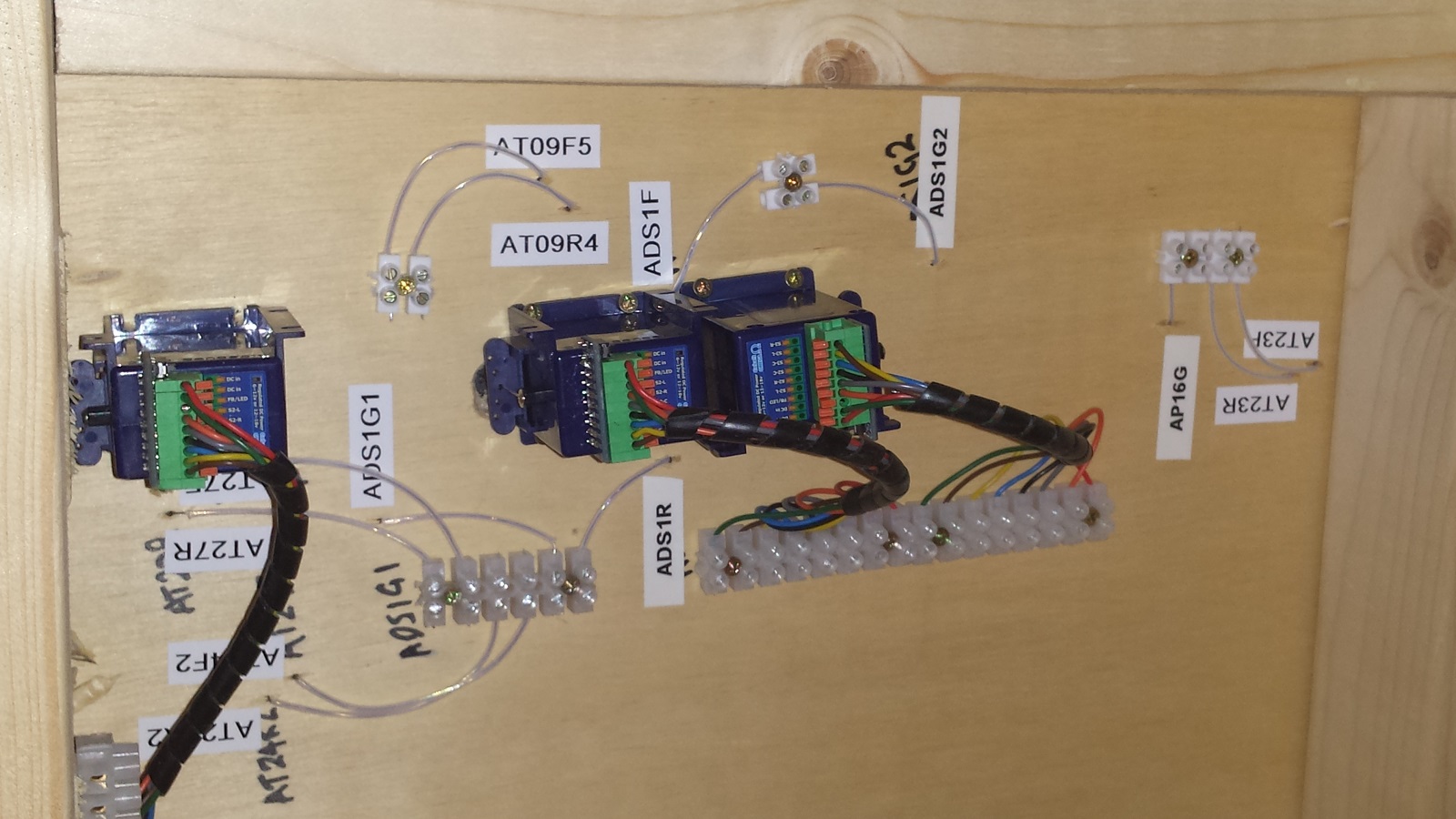
April 2015 The track for the final platform line has been laid down. With the benefit of hindsight, I probably shouldn't have done this (the one next to the wall) as its a bit of a stretch. I use pieces of wood as weights to apply a reasonable amount of pressure. I shall leave the engine shed area for later as I'm still fiddling with the plan. Next I have to solder feeders to every single piece of rail and feed them below the surface. I don't rely on fishplates for electrical connectivity. |
 |
May 2015 Every component has its own identity code and every connection has its i/d as well. So a point will need feed, return and frog connections. I used to use bell wire for the droppers but that was too fragile. I now use 24 gauge tinned copper wire with a clear PTFE sleeve. I started by using 20 gauge wire but that's too thick. Every dropper needs to be labelled otherwise it gets very confusing when you're looking at it upside down. I use a standard wiring colour scheme for every point motor. The chocblock terminal block connections aren't ideal but any alternative would be expensive given the number of connections. Here I used DCC concepts Cobalt Point Motors as they looked like a good idea. On my previous attempt, I used Tortoise motors which have been reused on this layout. The Cobalt motors aren't as reliable as the Tortoise motors. I've never had a fault with the Tortoise motors and I can't say that about the Cobalt motors. |
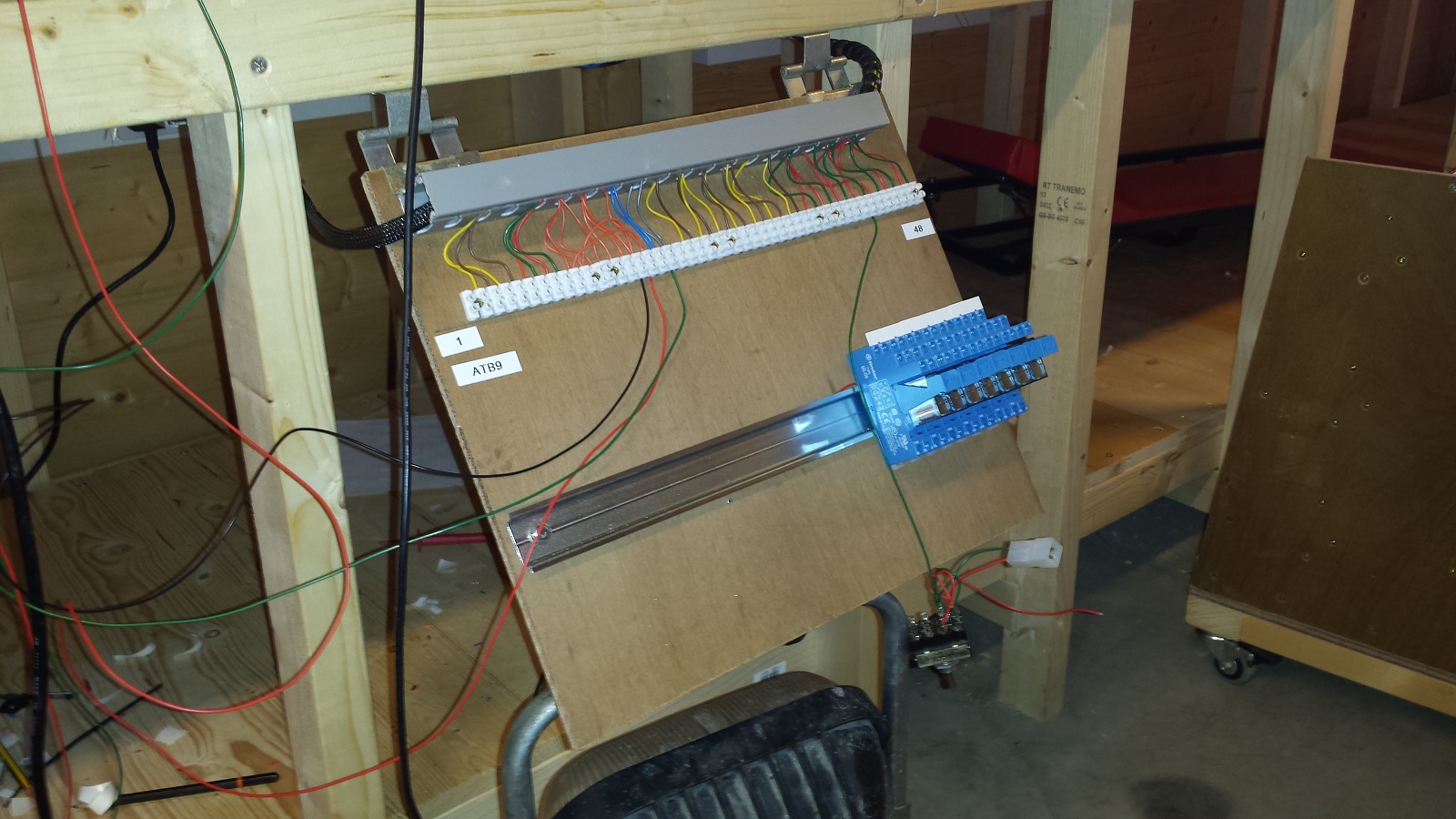 |
May 2016 Most of the wiring under the station is complete so it's time to start working on the boards that will control the layout. The plan is to use a PC for the terminal station with an entrance/exit control signalling system. This is going to need a lot of relays. The PC will talk to an interface device on each hinged board via a USB cable and the interface device will talk to the relays. Also the interface device will take the output from the point motors showing the route that has been set. I'm using these hinged boards that when they are complete will hinge upwards out of the way. The blue relays on the right of the board are double pole relays to control the point motors. The point motors operate by reversing the 12V supply. |
|
Back to Index | |
Next | |
Last | ||||
| 149 records found. Page 1 of 15 displayed. | |||||||||