

 |
First |  |
Previous |  |
Back to Index |  |
Next |  |
Last |
| 82 records found. Page 3 of 9 displayed. | |||||||||
For most of the photos on this page, you can click the image for a larger picture.
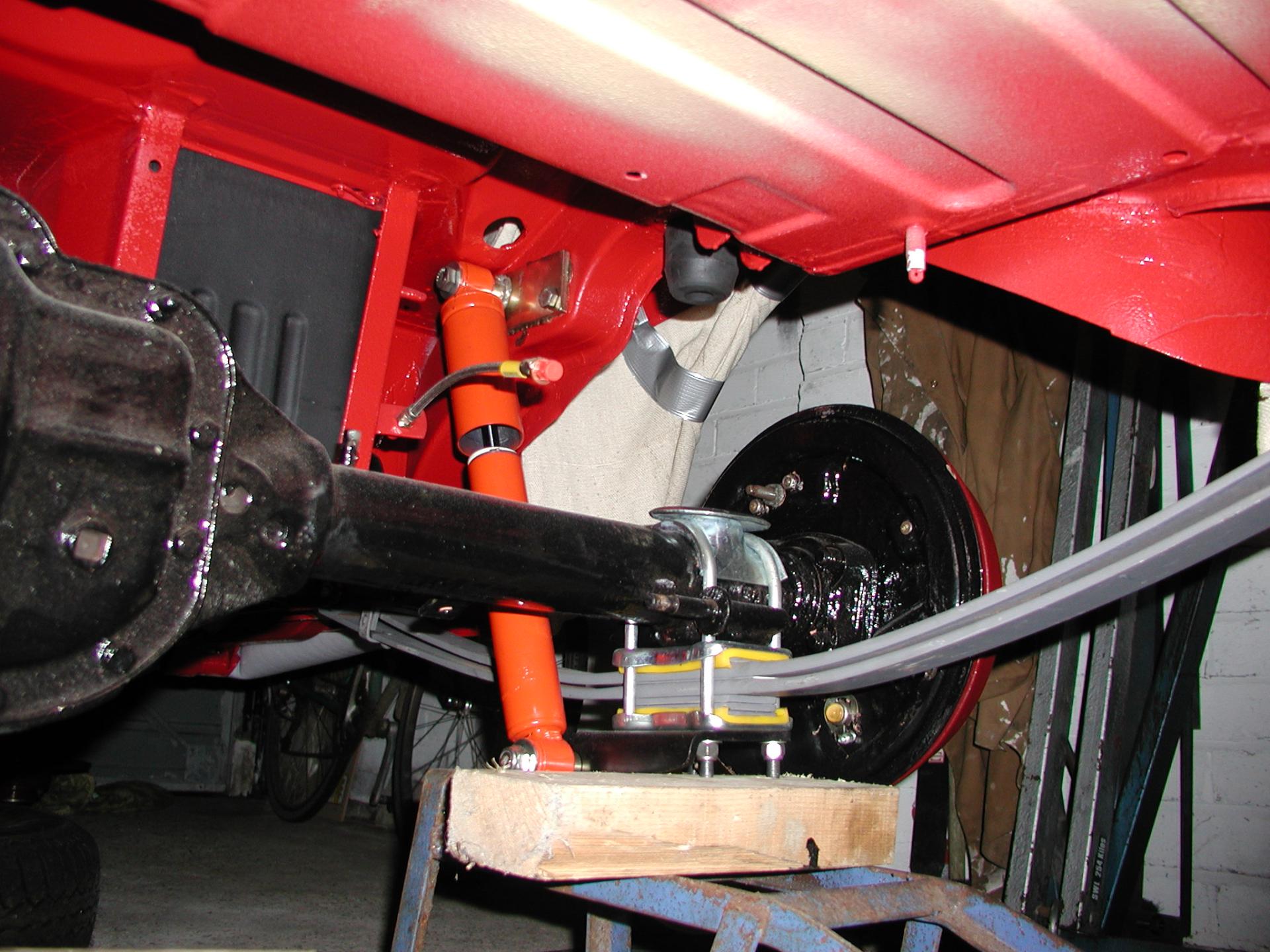
| Starting the Build - Suspension From this point onwards the project became really enjoyable. I had no detailed plan but it seemed logical to sort out the suspension, then do the plumbing (brakes) and then get the wiring in place before starting the engine. Once all these bits had been done, I could think about the interior. Sometimes, I switched to something else so as to add a bit of interest. It was vital to keep detailed notes of everything that had been fitted and I used my database application for this. I had been attempting to buy a block of parts with each month's pay during the autumn. This had the disadvantage of not being sure it would fit/work for several months but I never really hit any problems. It had the advantage of building up a pool of parts so I was rarely waiting for a part. For small parts, I would recommend MOSS every time. They supply all of the small parts individually bagged and labelled. MGOC supply all the small parts for an order in a single bag and it can be hard to work out what is what. However, the service from Moss Manchester is streets ahead of the service from Moss Bradford! All refurbished suspension parts received the Hammerite Number 1 primer/Smoothrite treatment after taking all of the rust and paint of with a wire brush on an angle grinder. Note not the red primer from Hammerite which is useless. The one advantage of wire brushing on a cold winter's night is that the drill gets nice and warm - it does a good job of keeping your hands warm! The doors and boot were removed and placed in the loft. The bonnet was removed and was too big to go in the loft so it had to go on the spare bed! I purchased a big roll of bubble wrap and covered the car in this. I then covered that with a painting cover from B + Q. This was an attempt to avoid scratches and bangs. Some words of warning about the rear springs. I fitted the spring as it came out of the wrapping - without changing the ride height packing. The MGOC advised that the axle restraining straps weren't required as the shock absorbers did the same job. Don't believe them! Once the axle was in place, it was impossible to fit the exhaust pipe as the axle sat too low. After crawling under an MG in a museum, I decided that the back axle was too low - the car too high - so I bought some straps. They pull the axle up enough to clear the exhaust. After finishing the build and driving it for the first time, I still felt the back end was too high so I moved 2 of the packing pieces on the spring from below it to above it. I think I'm happier now. You can see the original position in the fourth picture below. Another word of warning! Before setting off for the MOT, I decided to make a final check of the wheel spinners. As I tightened the front one, something in the back of my mind said that it was different to the way I had tightened the back one. Closer inspection showed the the front right hand spinner said 'LEFT SIDE' on it yet it had tightened up! I worked out that I had fitted the left hand front hub to the right hand side and vice versa. Better add that to the checklist next time. |
|
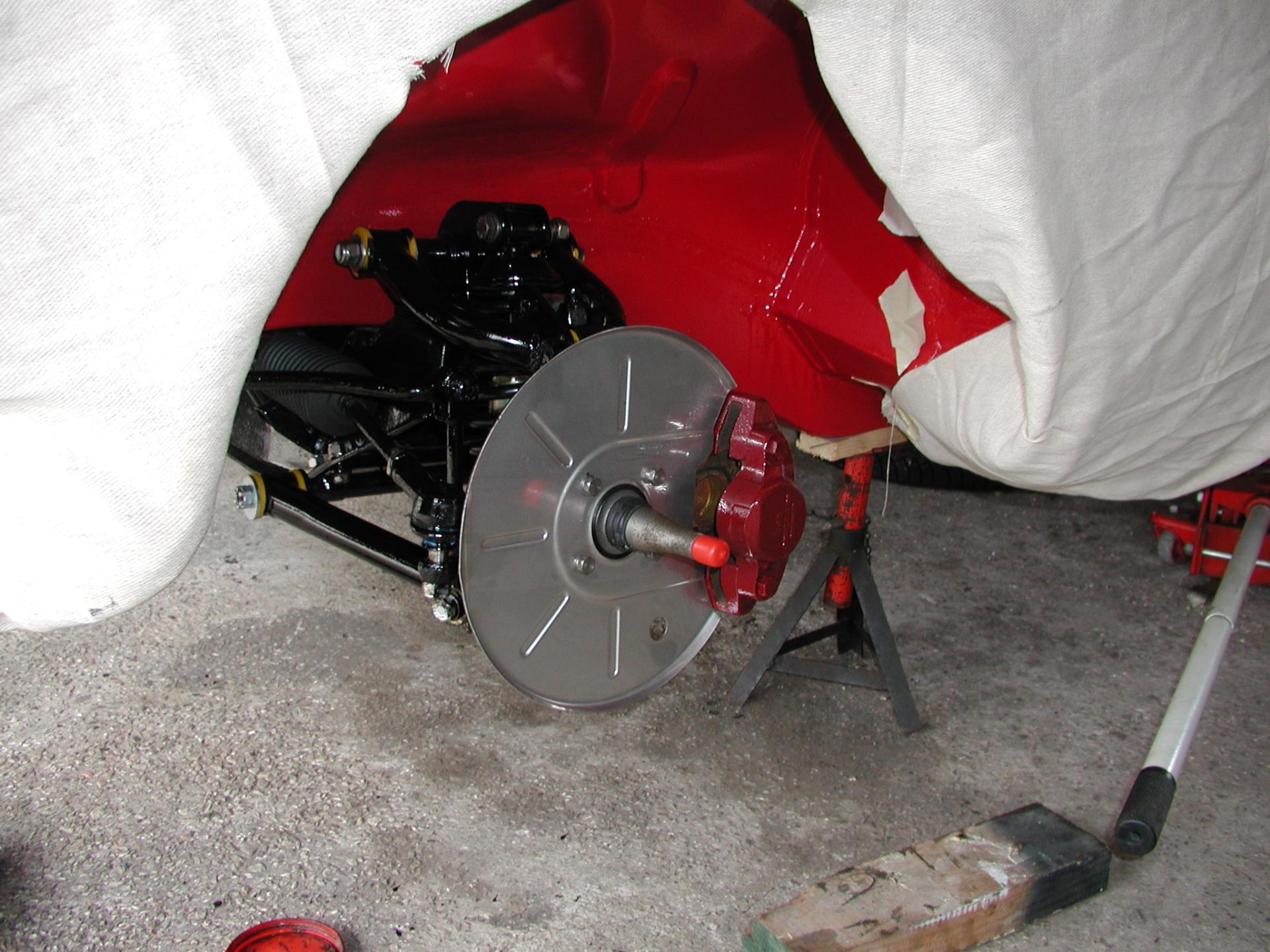 |
31 December MGOC sell some nice stainless steel disk backing plates (BTB412/3) - the original ones rot really quickly. The disk calipers are fitted. Long term note - I changed the brake pads some time after the rebuild and the backing plates polished up as new. |
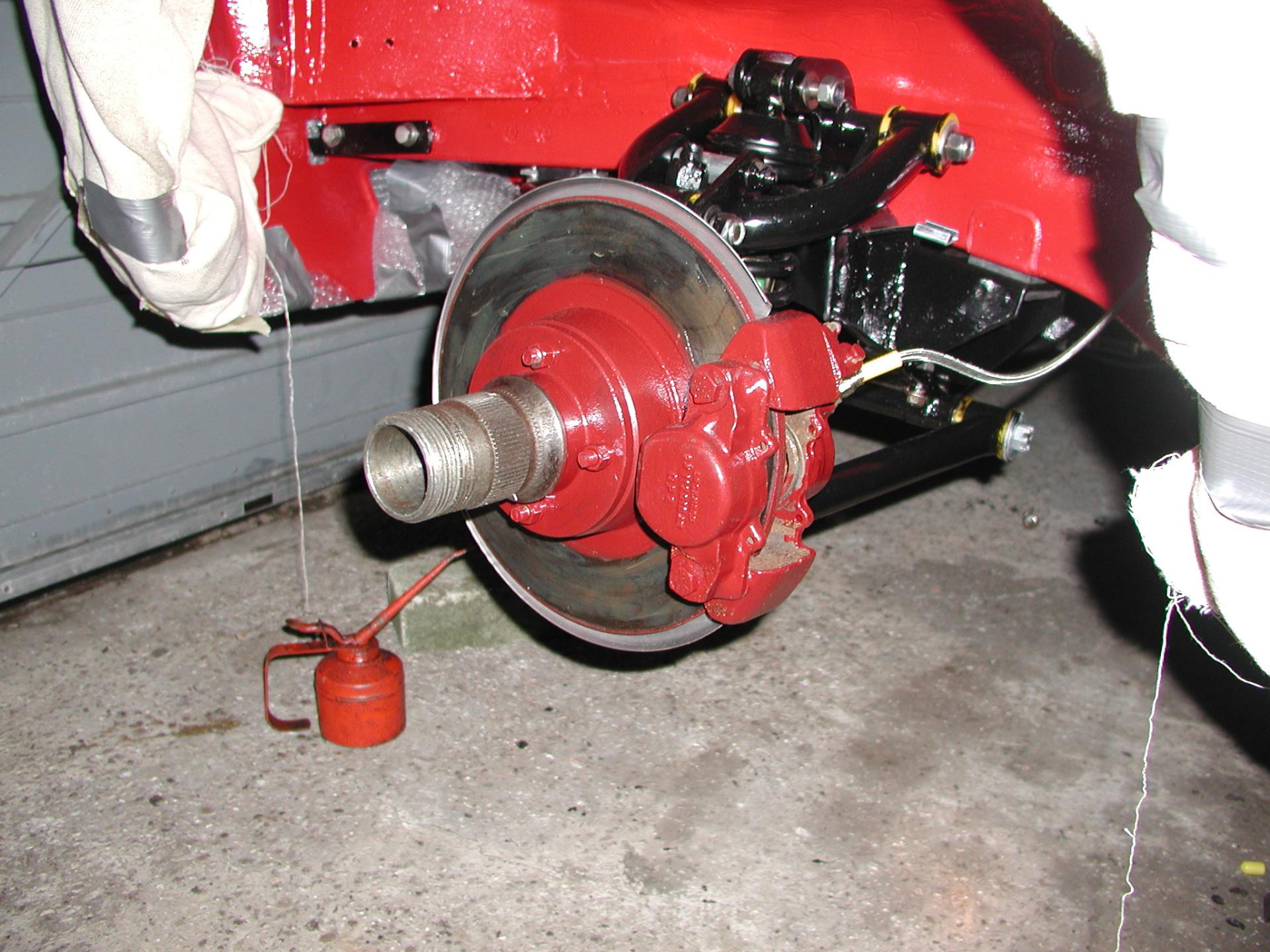 |
28 January Disks, bearings and brake pipes fitted. All parts painted with engine paint. The disks have been greased and the pads will not be fitted for some time. Flexible brake pipe is stainless. All straightforward stuff although I did manage to leave out the inter bearing spacer (a feature of MGs) and wondered why the bearing locked up when I tightened the retaining nut. I thought it best to replace the bearing after that. |
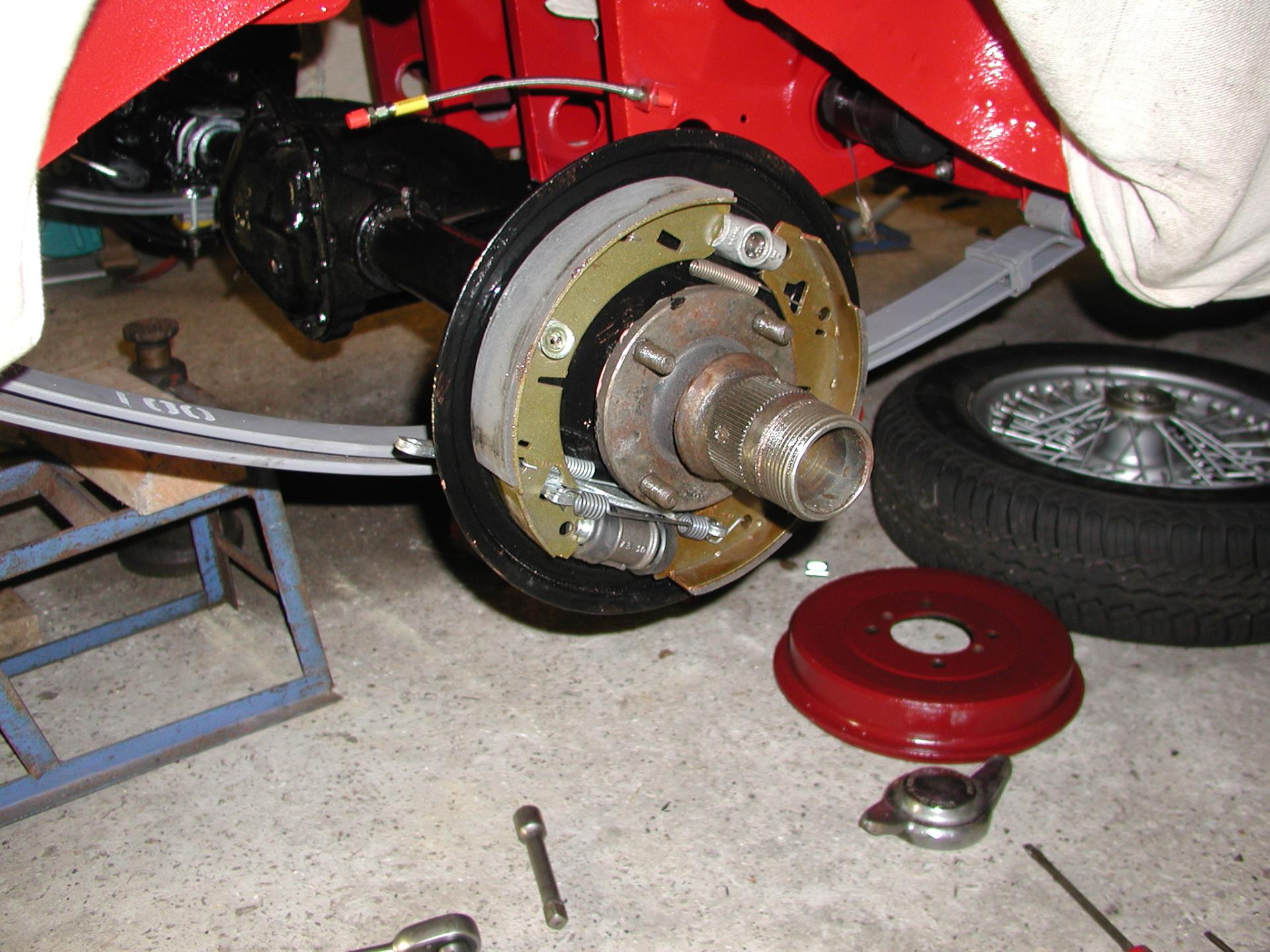 |
Getting the back axle into place was harder than the front crossmember. The spring shackles are the hardest bit. I used a G cramp to push them through the bushes. You can see my trusty bottle jack that gets pulled out for awkward jobs. I fitted the axle to the springs before attaching the springs which may have made it harder - I didn't try the other way so I can't tell! All the old brake gear looked tired so I replaced the lot. The one thing I want to work at all costs is the brakes. |
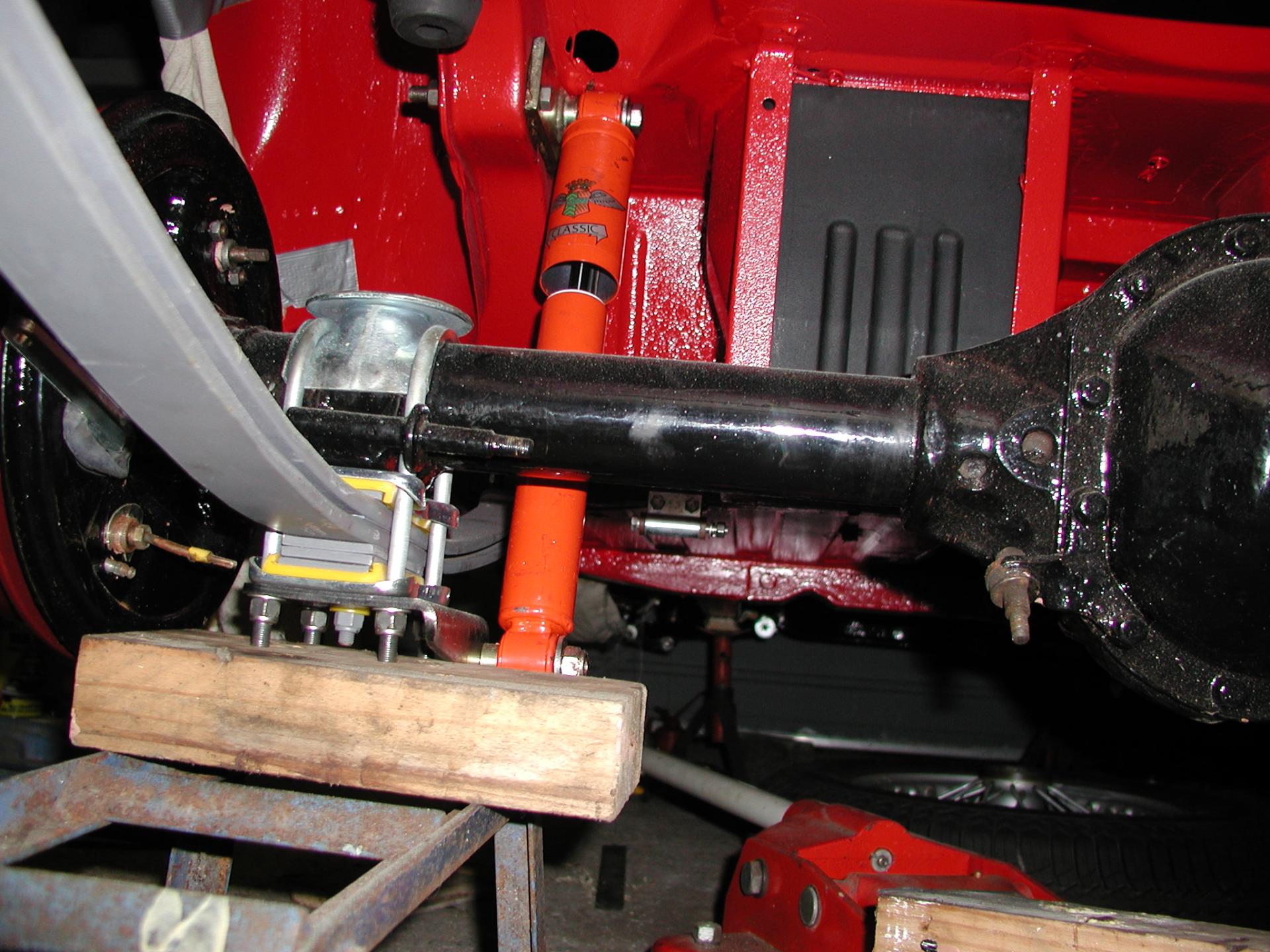 |
Here you can see the spring fitted with too high a ride height. I later moved 2 of the packing pieces to the top of the spring. The wheel cylinder has had the old brake pipe sawn off and then hammered flat as a temporary seal. I'm going to try and reverse the shock absorber bolts as I think the ends will rust badly if the thread end is in the wheel arch. As you can see, the spring tinware is new as the old ones were very moth eaten. The rubber bump stops are best fitted by boiling in water for half an hour! |
 |
A view on the other side. |
| Moving onto the Brakes and Plumbing Once the suspension had been fitted, it was time to move onto the brakes. As I'd already fitted the brake bits at the wheels, this task was mainly concerned with the master cylinders and piping. I'd be interested to know if anyone still installs steel pipes but, having had a pipe fail through rust (on a single pipe system!), it's copper for me every time. I did buy a brake pipe bending tool but I only really used it for straightening out the pipes from the box. Don't throw your old pipes away - they make a good model for bending the new pipes. Some comments about the heater which went in at the same time. This takes some ingenuity to fit. The old one was distorted from being extracted - it was also rusted in places - therefore I bought a replacement. I had to make several 'tweaks' before it went in and I shall be surprised if it ever comes out in one piece again. All of the mounting slots need filing as none of them lined up. If you look in the bottom photo at the backing washer at the top heater fixing bracket, you can see that I've had to use a repair washer as the hole was extended but that I've had to cut a 'flat' across the bottom so that it would fit. There is a sealing washer that's supposed to go in the well between the body and the heater. The Haynes Restoration manual says this isn't available and they made up on using foam sealant. MGOC now supply the sealing rubber but there was no way that I could get that to fit. To me, it's too thick or insufficiently compressible and the heater refuses to go in. I had to leave it out - the heater still seems to work. I also think that I had to file away some of the opening on the body to get it to go in. Fitting the heater was one of the worst jobs. Once the heater was finally in, a test of the heater motor gave a loud squealing sound. This was solved by opening up some of the holes in the mounting plate. I also fitted a second mounting plate - to give more thickness - which stopped another area of rubbing. In spite of this abuse, the heater works well. Before fitting the heater, make sure that you fit the drain tube (which has a delightful nickname) to the heater plenum chamber in the bodyshell. You can't buy the drain tube at the moment. You need to make sure all of the rust is removed from inside the old one. |
|
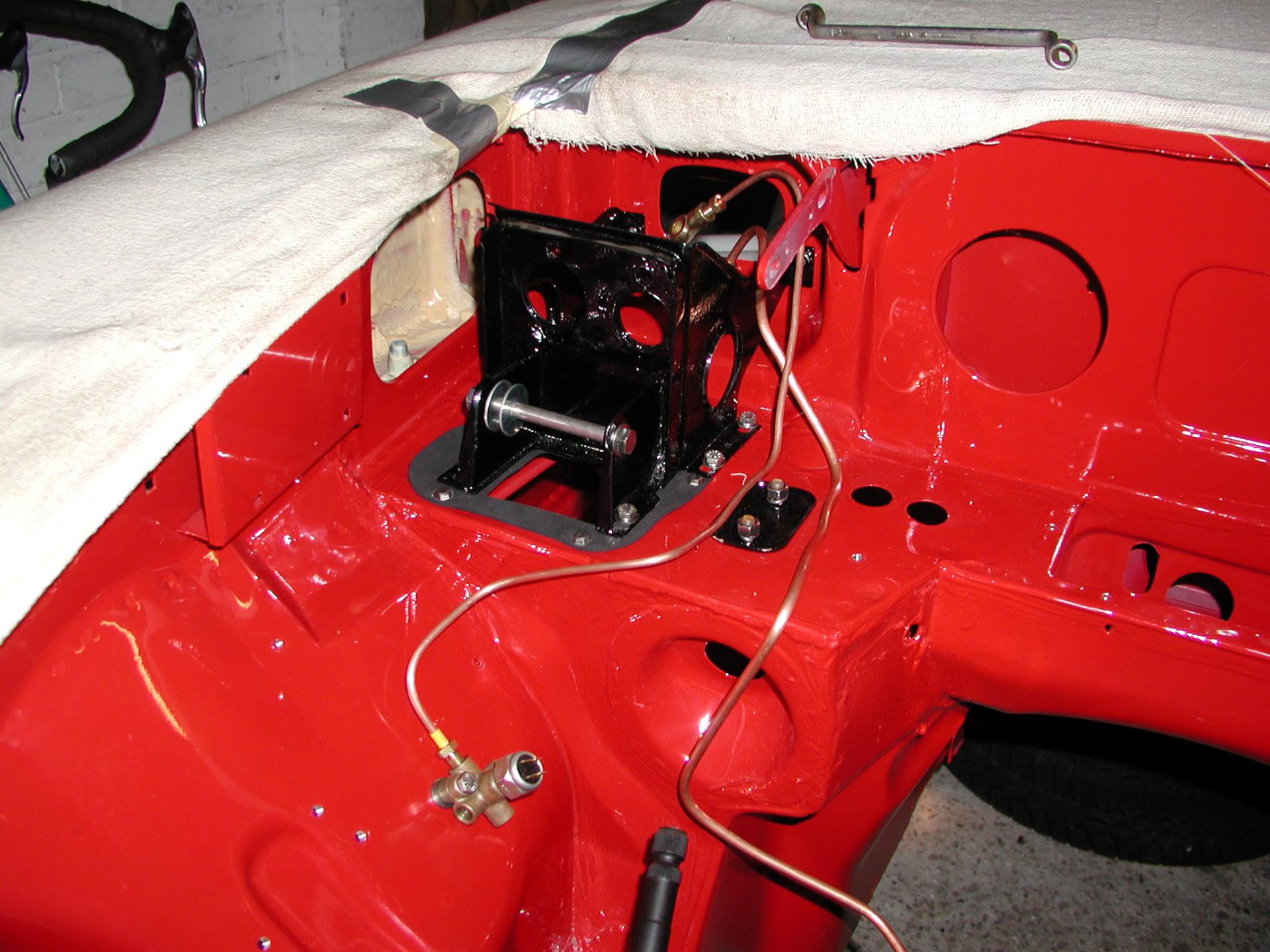 |
Here's the pedal box fitted. It didn't fit first time. I needed to file out the mounting slots so that they aligned with the holes. By the way, a UNF tap and die set was invaluable as I had to clean out every hole on the body - make sure you get a set with a 3/16" one in. The pedal box was grit blasted as it's a difficult shape to wire brush. I took it to my local motorcycle restorer who stove enamelled it at the same time. I had to fight the horizontal arms at the back of the pedal box to get them to fit. The steering column bracket was also fitted as the brake pipes clip to this. The brake and clutch pipes were bent using the old ones as templates. You can see that the inner wing has had a healthy coating of Waxoyl. |
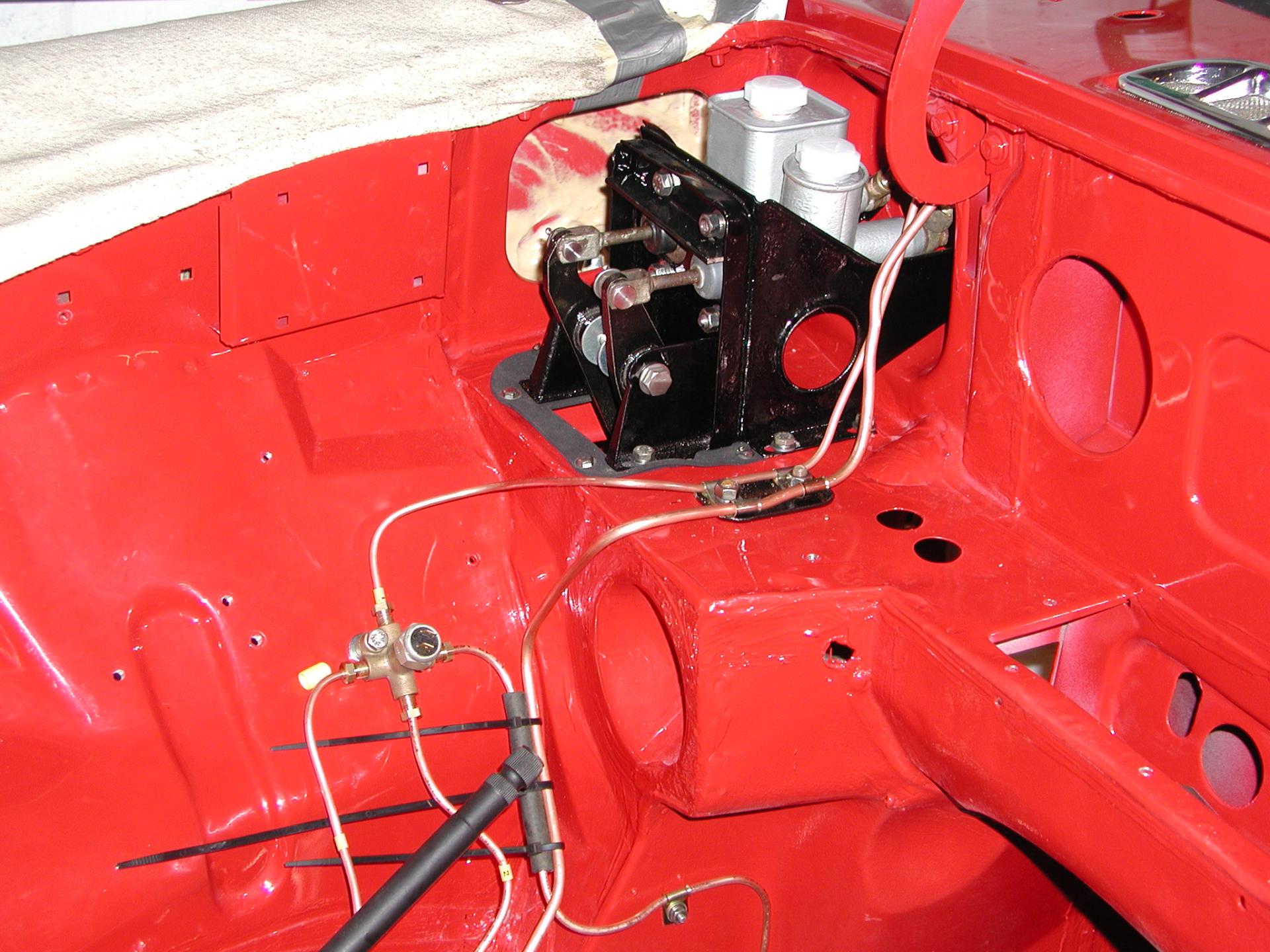 |
Master cylinders were wire brushed, painted and overhauled. Here the master cylinders have been fitted. You can see that it's not easy as I've managed to dislodge a lot of the Waxoyl. It's much easier like this - later on, the clutch cylinder had to be replaced with a new one and its not very easy with everything in place. In the photo, most of the plumbing is in place. As the brake and clutch pipes were so close, I fitted a rubber tube sleeve around one pipe and then tie wrapped them together. |
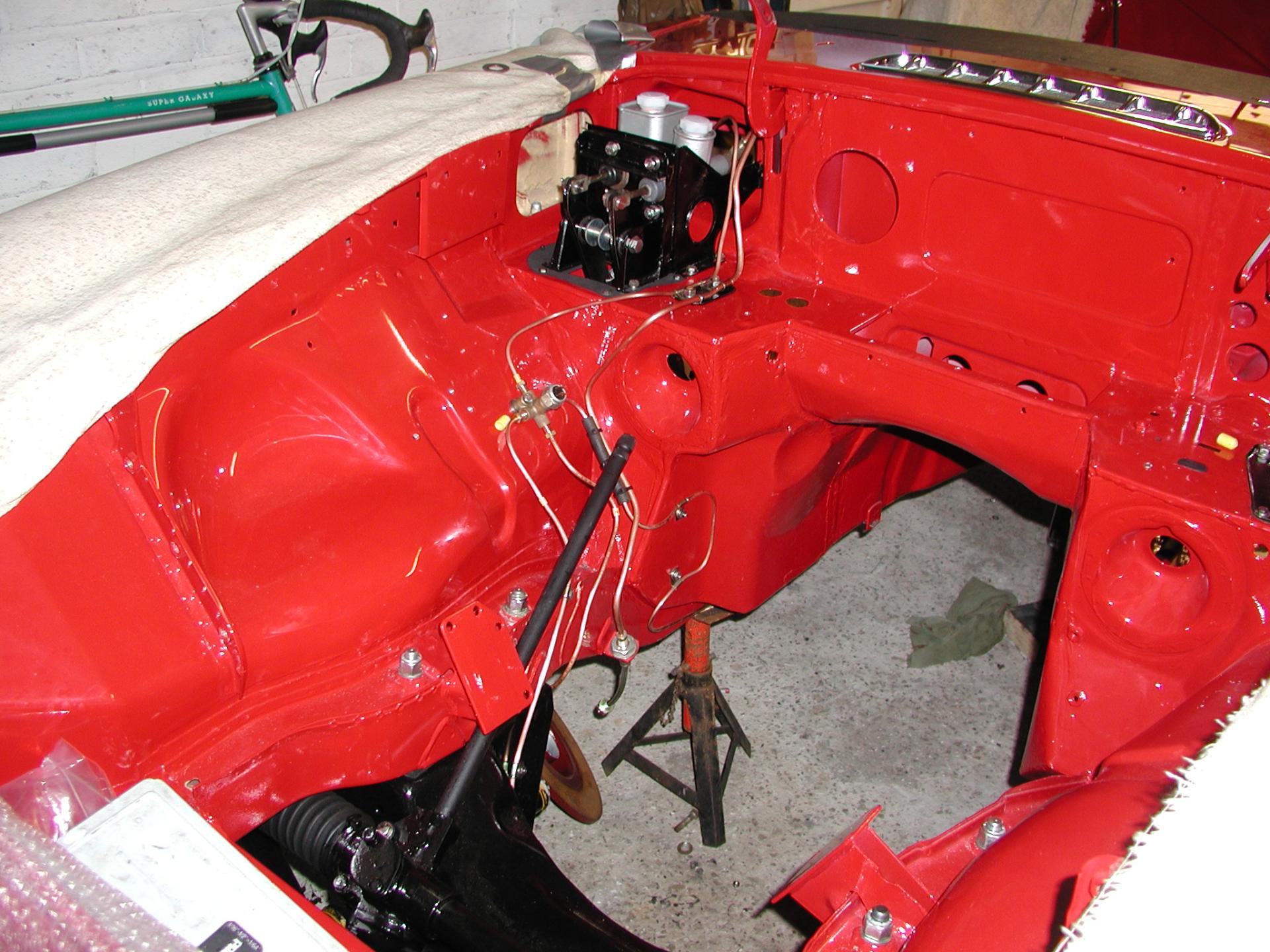 |
This is taken standing back a bit. The pipe that runs from the rear axle to the brake light switch had more pipe than I needed so I had to create a loop. Apart from this one, the pipes were all about right. |
|
First | |
Previous | |
Back to Index | |
Next | |
Last |
| 82 records found. Page 3 of 9 displayed. | |||||||||